
The idea in brief.
Cash moving into an account is an observation. Calling it revenue is an interpretation. A useful financial view preserves the source and purpose of the movement before it becomes an input to affordability or business analysis. [1]
- Classify operating, financing, and transfer flows separately.
- Use source documents to explain large or unusual movements.
- Preserve uncertain classifications so a reviewer can correct them.
The issuer example is a public disclosure. The account-reconciliation example is hypothetical and does not describe an Amlok customer.
The amount does not explain the purpose
A business account can receive customer payments, a loan draw, an owner contribution, a tax refund, or a transfer from another owned account. These movements all increase the observed balance, but they have different implications for recurring cash generation and future obligations.
Amlok’s public-record research uses Kinross’s March 2022 USD 1 billion term-loan announcement as an example. The financing refinanced acquisition-related revolving borrowings. Treating the inflow as operating revenue would lose the obligation and the refinancing purpose. The source announcement provides context a bank line alone cannot establish. [2][3]
Follow the economic event
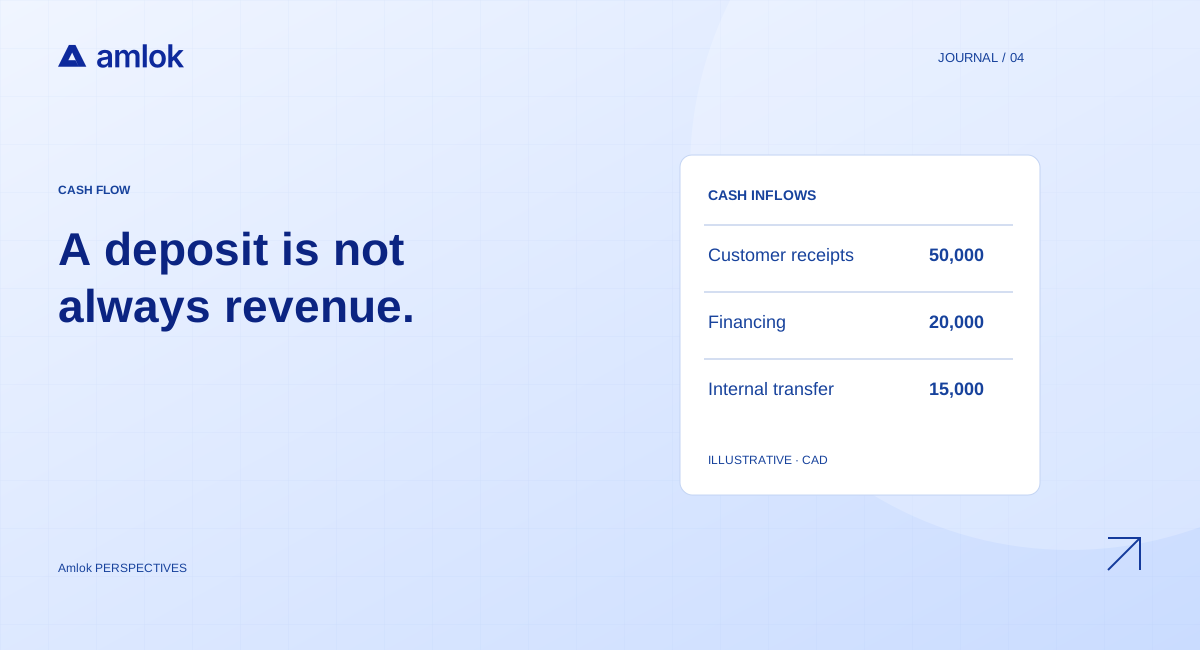
Consider a hypothetical business receiving CAD 50,000 from customers and CAD 20,000 from a loan. It then transfers CAD 15,000 from one owned account to another. Summing the positive entries across both accounts would produce CAD 85,000. The customer receipts are still CAD 50,000; the loan is financing, and the transfer is internal movement.
For a consolidated cash view, match both sides of the transfer and retain them in the audit trail while excluding the duplicated inflow from operating receipts. Do not delete the transactions: the movement may matter for liquidity and account-level reconciliation even though it creates no new group income. [4]
Positive bank entries are not all operating receipts
View figure data
| Measure | Value |
|---|---|
| Summed positive entries | CAD 85,000 |
| Customer receipts | CAD 50,000 |
Leave uncertainty in the record
Transaction descriptions are often incomplete. A name match or recurring amount may suggest a category without proving it. Record the evidence used for the classification, the confidence or review state, and any alternative explanation. A reviewer should be able to inspect a suspiciously large “sales” item before it drives a decision.
An unresolved amount can be shown in a separate reconciliation category. That is preferable to forcing every transaction into a definitive label. The residual itself can guide a targeted request for an invoice, facility statement, or explanation. [1]
Compare consistent windows
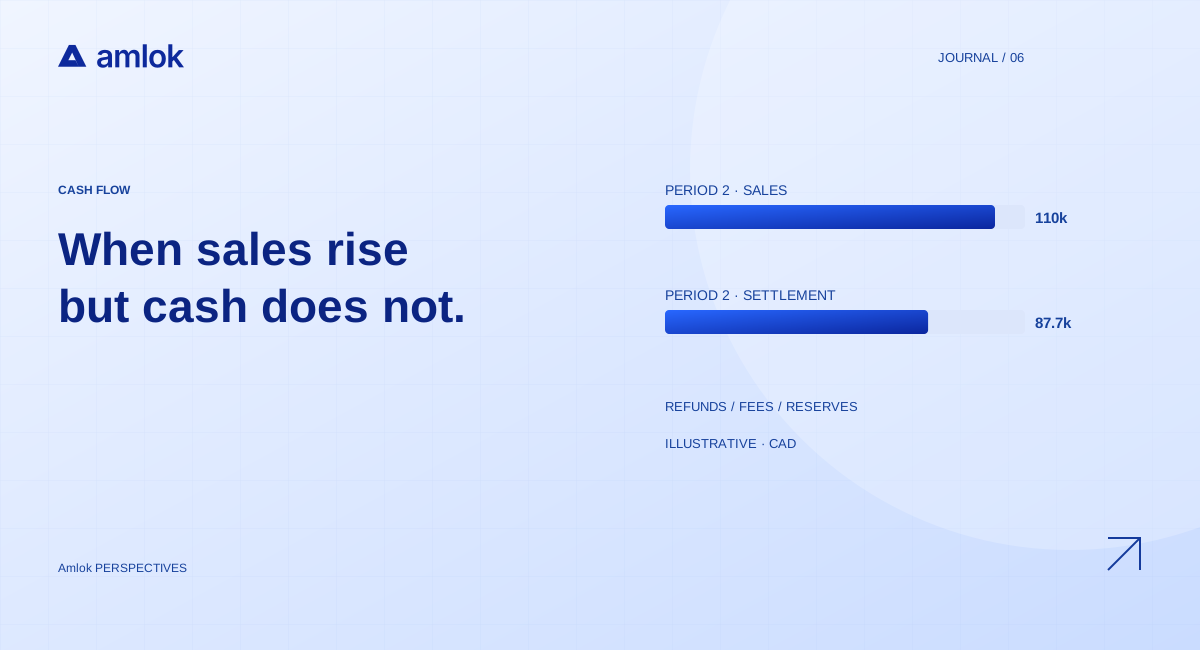
Even correctly classified receipts can mislead when the windows differ. A five-week month, a settlement delay, or a newly connected account can change totals without a comparable change in the business. Show the observation period and coverage beside the calculated measure.
For a monitoring study, evaluate both classification quality and the resulting signal. A corrected financing classification can lower a historical operating-receipts estimate without indicating a new deterioration. Preserve the revision history so the institution understands whether the business changed or the evidence improved. [5]
Sources & methodology.
Figures identify their population, period, and units. Scenarios marked illustrative are Amlok calculations using stated assumptions, not observed customer outcomes.
- 1Financial analysis and evidenceAmlok research and product documentation
Definitions, reconciliation, and analytical methods; implementation guidance rather than measured portfolio performance.
- 2Findings from public financial recordsAmlok research and product documentation
Source-level cases and extraction checks. Public disclosures are not private borrower histories.
- 3Kinross announces US$1.0 billion term loanKinross · 7 March 2022
Issuer announcement: refinancing of acquisition-related revolving borrowings, not operating revenue.
- 4Financial record modelAmlok research and product documentation
Proposed representation of source, entity, amount, period, event time, and knowledge time.
- 5Monitoring and change detectionAmlok research and product documentation
Proposed monitoring design, observation windows, baselines, and evaluation requirements.