Amlok

The idea in brief.
Merchant finance depends on the conversion of sales into usable cash. That conversion can be interrupted by refunds, processor reserves, seasonality, or competing obligations even when gross sales look healthy. This guide builds a reviewable cash-flow assessment around the actual settlement chain. [1]
- Reconcile a sale through refunds, fees, reserves, and bank settlement before calling it available cash.
- Separate a weak trading period from a broken data connection or shifted settlement schedule.
- Evaluate the actual contract and existing obligations; gross receipts alone do not establish capacity.
Historical US research provides context; the operating examples are explicitly hypothetical CAD scenarios. No Amlok merchant-loss model, advance-size recommendation, or universal remittance threshold is validated by this guide.
One sale, several observations
A point-of-sale order, processor transaction, settlement batch, and bank deposit can describe the same underlying sale. Adding them as independent revenue inflates the business. A useful record links these observations while preserving their different dates, amounts, and source identifiers. Transfers between the merchant’s own accounts should also remain distinct from customer receipts. [2][3]
Build the reconciliation by settlement batch where possible. Start with captured sales, subtract refunds and chargebacks, then account for processing costs, reserve movements, and other adjustments. Compare the calculated payout with the bank receipt after allowing for the processor’s timing conventions. An unexplained residual should remain visible; forcing it into revenue creates false certainty.
Keep the customer order date, capture date, settlement date, and bank posting date separately. A long weekend can shift receipts without changing economic activity. A settlement hold can leave sales intact while reducing liquidity. The analytical response should depend on which part of the chain changed.
Follow one economic event
- 01Sale
What was purchased, when, and through which channel?
- 02Adjustments
Refunds, disputes, fees, and reserve movements.
- 03Payout
The processor’s net settlement and expected date.
- 04Bank receipt
The deposited amount, matched to its batch.
Use cash buffers as context
JPMorgan Chase Institute’s historical US study used 597,000 small businesses observed from February through October 2015. Median cash buffer days were 27; the 25th and 75th percentiles were 13 and 62. The measure divides average daily cash balances by average daily outflows. These are descriptive findings from a selected historical sample, not current Canadian MCA policy thresholds. [4]
For an individual merchant, first decide what cash can actually be used. Restricted reserves, tax amounts held for remittance, or balances in an inaccessible account may not support near-term operations. Then align the denominator with the question: normal operating outflows, all scheduled payments, or a stressed spending plan produce different runway measures.
A low buffer may reflect a deliberate sweep arrangement rather than distress. A high balance may reflect a recent financing deposit rather than operating resilience. Record the explanation and assess the time series. The ratio should open a review of liquidity, not end it.
Cash buffers vary widely
View figure data
| Measure | Value |
|---|---|
| 25th percentile | 13 days |
| Median | 27 days |
| 75th percentile | 62 days |
Work through a settlement bridge
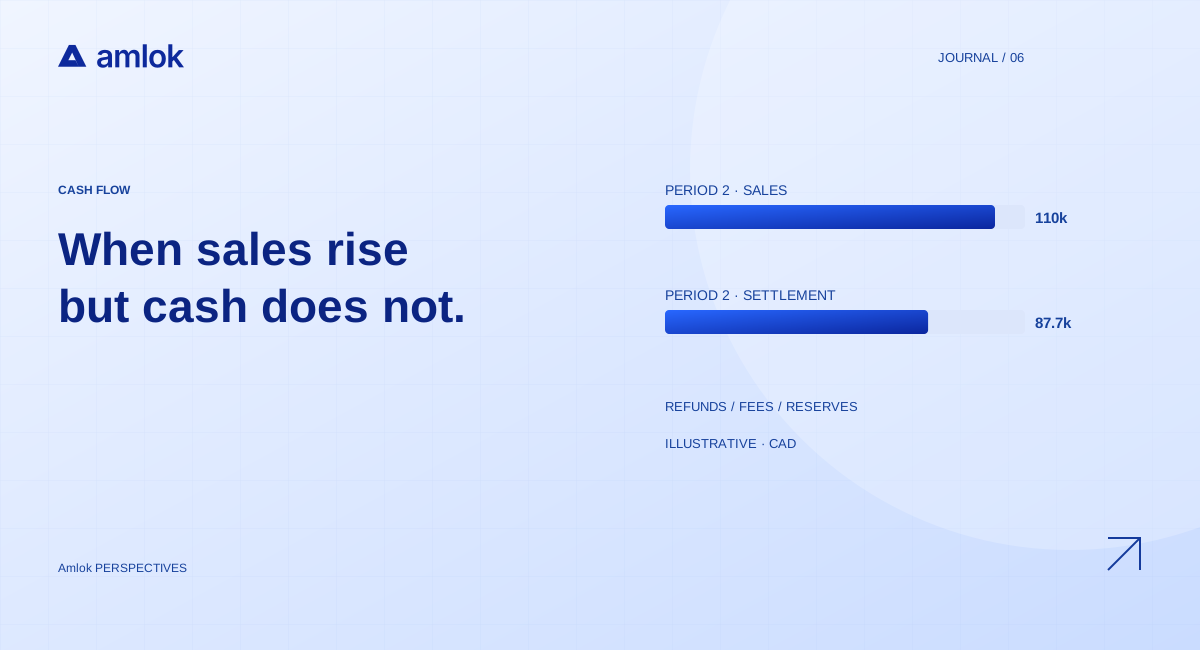
Consider a hypothetical merchant with CAD 120,000 in captured monthly sales. Refunds are CAD 6,000, processing fees CAD 3,000, and the processor adds CAD 4,000 to reserves. Ignoring other adjustments, the expected settlement is CAD 107,000. A bank feed showing CAD 107,000 is consistent with the bridge; counting both sales and the bank receipt would incorrectly report CAD 227,000 of economic inflow.
Now assume operating cash costs of CAD 82,000 and scheduled remittances of CAD 18,000. The simplified monthly residual is CAD 7,000. If captured sales fall 15%, refunds remain 5% of sales, fees remain 2.5%, the reserve addition stays CAD 4,000, and other costs remain fixed, settlement becomes CAD 90,350. The residual becomes negative CAD 9,650.
This calculation isolates sensitivities. It does not establish what the merchant legally owes in the stressed month. Percentage-based remittance, reconciliation rights, reserve rules, and contract-specific provisions may change the cash schedule. Model those terms directly and show when a calculation assumes fixed payments. [1]
| Item | Base | 15% lower sales |
|---|---|---|
| Captured sales | 120,000 | 102,000 |
| Refunds at 5% | −6,000 | −5,100 |
| Fees at 2.5% | −3,000 | −2,550 |
| Reserve addition | −4,000 | −4,000 |
| Settlement | 107,000 | 90,350 |
| Operating cash costs | −82,000 | −82,000 |
| Assumed scheduled remittances | −18,000 | −18,000 |
| Residual | 7,000 | −9,650 |
Find the source of volatility
Compare like with like: weekday to weekday, trading week to trading week, and comparable seasonal windows. Document closures, channel changes, and incomplete observations before interpreting a movement. A rolling average can smooth genuine noise while also concealing a recent break, so show both the current window and its reference period.
Inspect customer and channel concentration as well as totals. A merchant can maintain revenue while becoming dependent on one marketplace or buyer. Refund timing, dispute volumes, and reserve changes help explain the quality of those receipts. A category label without a source transaction should be treated as an inference that a reviewer can challenge.
External research can motivate which patterns to examine; it cannot supply the merchant’s missing data. Missing settlement files should produce a coverage exception. They should not be converted into zero sales, nor should last month’s complete data be silently presented as current. [5]
Evaluate the review process
A pilot should compare a frozen set of merchant files under the current review process and the proposed evidence-led process. Measure reconciliation completeness, unresolved residuals, reviewer agreement, and time to a documented decision. Track which sources were missing; otherwise a faster result may simply reflect easier cases.
If later studying repayment outcomes, define the contract-specific event, observation horizon, and treatment of renewals before scoring. Separate merchants and related entities across partitions and preserve a later evaluation period. Report uncertainty and performance by channel, season, and evidence coverage. Operational improvements should not be described as lower losses unless loss outcomes were actually measured. [6]
In Amlok’s product framing, underwriting assembles the baseline and monitoring follows changes. The institution remains responsible for the decision and the response. A useful handoff includes the settlement bridge, obligations, assumptions, disputed classifications, and the next review date, rather than just a single score. [1]
Sources & methodology.
Figures identify their population, period, and units. Scenarios marked illustrative are Amlok calculations using stated assumptions, not observed customer outcomes.
- 1Merchant cash advance workflowsAmlok research and product documentation
Industry-specific data and assessment scope. Contract terms and institutional policy govern any remittance decision.
- 2Financial record modelAmlok research and product documentation
Proposed representation of source, entity, amount, period, event time, and knowledge time.
- 3Embedded finance workflowsAmlok research and product documentation
Data coverage, consent, platform context, and economic-event reconciliation.
- 4Cash Flows, Balances, and Buffer DaysJPMorgan Chase Institute · September 2016
Historical US sample of 597,000 small businesses, February–October 2015. Cash buffer days use average daily balances divided by average daily outflows. Not a Canadian lending threshold.
- 5Monitoring and change detectionAmlok research and product documentation
Proposed monitoring design, observation windows, baselines, and evaluation requirements.
- 6Evaluation designAmlok research and product documentation
Evaluation protocols and research objectives. A specified protocol is not evidence that an experiment has been completed.