
The idea in brief.
Gross sales and bank receipts move on different clocks. Refunds, disputes, fees, reserves, and payout timing can widen the gap. A merchant-finance review should explain that bridge before drawing a conclusion about capacity. [1]
- Reconcile processor activity to actual payouts.
- Inspect changes in adjustments and timing alongside sales.
- Apply the merchant’s actual contractual terms when evaluating remittances.
All amounts in this article are illustrative CAD values. The scenario is an analytical example, not a merchant case study or contract recommendation.
A larger top line can hide a smaller payout
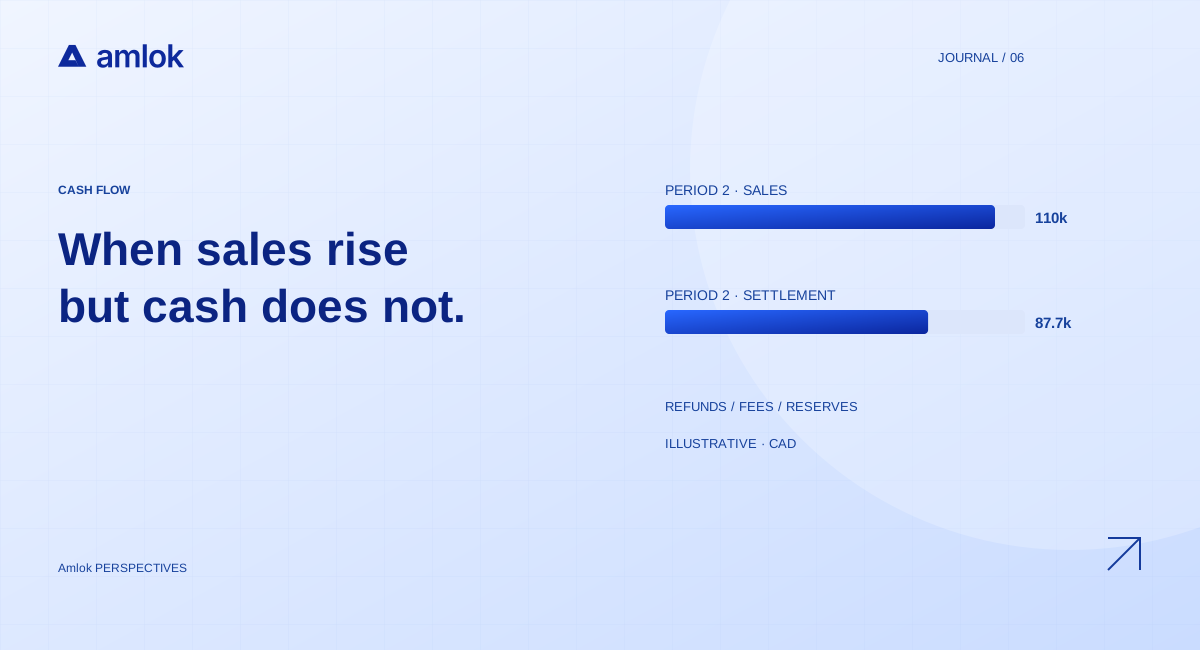
Imagine a merchant’s captured sales rise from CAD 100,000 to CAD 110,000. In the first period, refunds are CAD 5,000, fees CAD 3,000, and reserve additions CAD 2,000, leaving CAD 90,000 to settle. In the second, refunds rise to CAD 9,000, fees to CAD 3,300, and reserve additions to CAD 10,000. Settlement falls to CAD 87,700.
Gross activity grew 10%, while the expected payout fell about 2.6%. Neither number is wrong. They describe different stages of the same economic flow. A review that sees only the sales growth can miss the tightening liquidity; one that sees only the payout decline can miss its cause.
The settlement bridge changes the story
View figure data
| Measure | Value |
|---|---|
| Period 1 · captured sales | 100.0 |
| Period 1 · settlement | 90.0 |
| Period 2 · captured sales | 110.0 |
| Period 2 · settlement | 87.7 |
Different causes need different questions
A reserve increase may be temporary, contractually scheduled, or associated with a changed processor risk assessment. Refunds may reflect seasonality, a product issue, or timing from an earlier sales period. The amount alone does not identify the cause.
Retain adjustment codes, relevant processor notices, and the sales periods to which refunds relate. If payouts are delayed, compare expected and actual settlement dates. A missing file should be classified as a coverage problem until the evidence shows otherwise. [1][2]
Keep the merchant’s contract in view
A simplified fixed-payment stress can be useful for sensitivity analysis, but it may not represent a contract whose remittances vary with receipts or include reconciliation provisions. The actual terms determine how a changing payout affects scheduled cash obligations.
List existing obligations and their cash timing. Do not infer that a positive monthly residual guarantees every daily payment can be met. A settlement calendar, opening accessible cash, and major operating expenses can reveal a timing pressure that a monthly average conceals. [3]
Turn the bridge into a review artifact
A useful packet contains the two reconciled periods, the components explaining the change, outstanding mismatches, and the institutional question that needs an answer. It should make it easy to distinguish lower sales from a higher holdback or a delayed payout.
For evaluation, compare the bridge with reviewed source records and track unexplained residuals. Any claim that this analysis predicts losses needs a separate outcome study with a defined target, horizon, and cohort. Accurate reconciliation is valuable evidence; it is not itself a validated credit score. [4]
Sources & methodology.
Figures identify their population, period, and units. Scenarios marked illustrative are Amlok calculations using stated assumptions, not observed customer outcomes.
- 1Merchant cash advance workflowsAmlok research and product documentation
Industry-specific data and assessment scope. Contract terms and institutional policy govern any remittance decision.
- 2Financial record modelAmlok research and product documentation
Proposed representation of source, entity, amount, period, event time, and knowledge time.
- 3Financial analysis and evidenceAmlok research and product documentation
Definitions, reconciliation, and analytical methods; implementation guidance rather than measured portfolio performance.
- 4Evaluation designAmlok research and product documentation
Evaluation protocols and research objectives. A specified protocol is not evidence that an experiment has been completed.