
The idea in brief.
A sensitive detector can still create an unmanageable queue when the event it seeks is rare. Monitoring needs an explicit operating point and a clear review action, not simply more signals. [1]
- Report precision and workload alongside sensitivity.
- Group related observations into a reviewable case.
- Separate data-quality alerts from economic-change alerts.
The confusion-matrix example is hypothetical. It is not a measured Amlok result or a proposed universal threshold.
Start with the base rate
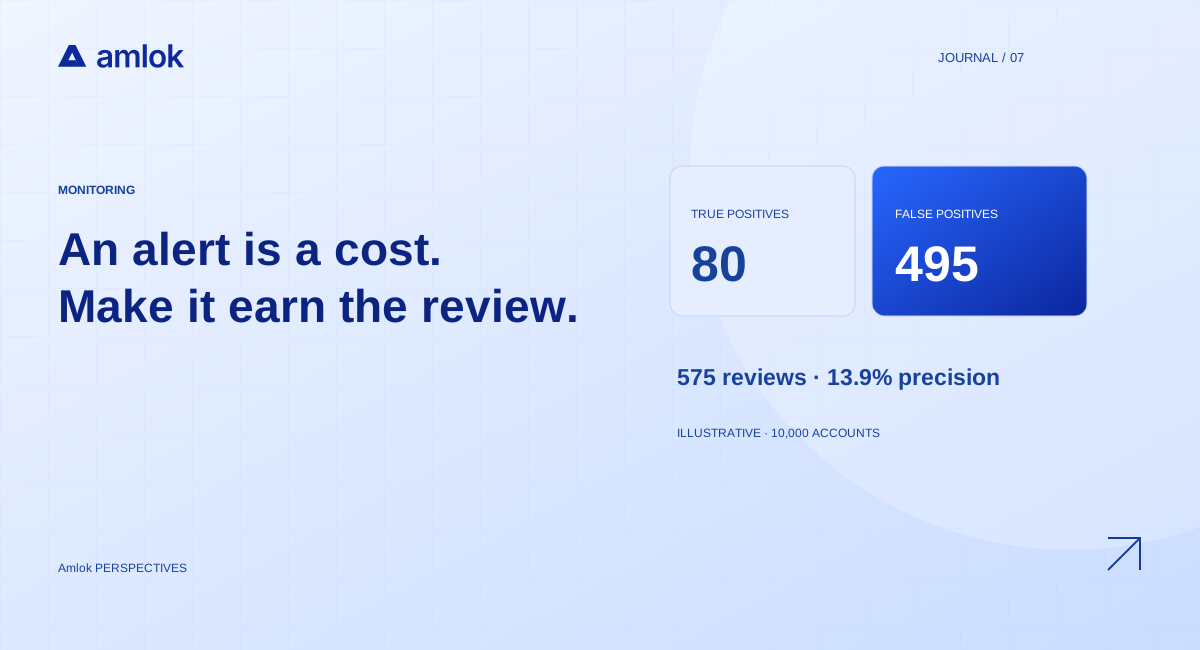
Assume a hypothetical population of 10,000 accounts contains 100 cases with a defined event during the evaluation window. A detector catches 80 of those cases, giving 80% sensitivity. If it also flags 5% of the other 9,900 accounts, it produces 495 false positives.
The review queue contains 575 cases, of which 80 are true positives. Precision is therefore 80 ÷ 575, or about 13.9%. There are also 20 missed events. Calling the detector “80% effective” would conceal most of the operational picture.
A rare event can produce a noisy queue
View figure data
| Measure | Value |
|---|---|
| True-positive alerts | 80 |
| False-positive alerts | 495 |
| Missed events | 20 |
Define the work the alert creates
A reviewer needs to know what changed, which evidence supports it, and what action is available. If ten correlated observations describe the same payment interruption, ten separate cases may add workload without adding information. Grouping should preserve the original evidence and make its relationship explicit.
Estimate the review burden at candidate thresholds before deployment. Queue size, review time, escalation rate, and unresolved cases are relevant measurements. An institution with limited capacity may need a different operating point from one with a dedicated specialist team. [2]
Do not mix missing data with deterioration
A source outage can reduce observed receipts across many accounts simultaneously. Treating each as an economic shock produces a burst of misleading alerts. Monitoring should first identify source health and affected calculations, then distinguish incomplete observations from verified changes.
A data-quality case can still be urgent if it prevents an important review. It should simply be labelled according to its actual cause. This allows the right team to restore the evidence rather than sending every affected borrower into the same financial-risk workflow. [3]
Evaluate the response, not just the detector
Fix the target event and horizon before selecting a threshold. Evaluate on a later period and report uncertainty, coverage, and cohort differences. Keep the missed-event analysis visible; suppressing alerts can improve apparent precision while leaving important cases unseen.
An earlier warning is useful only if a timely, appropriate response is possible. Log the action, its rationale, and the subsequent outcome. A causal claim that the response reduced losses needs stronger study design than a retrospective correlation between an alert and an event. Amlok’s existing public baselines do not establish that effect. [1][4]
Sources & methodology.
Figures identify their population, period, and units. Scenarios marked illustrative are Amlok calculations using stated assumptions, not observed customer outcomes.
- 1Evaluation designAmlok research and product documentation
Evaluation protocols and research objectives. A specified protocol is not evidence that an experiment has been completed.
- 2Monitoring and change detectionAmlok research and product documentation
Proposed monitoring design, observation windows, baselines, and evaluation requirements.
- 3Financial record modelAmlok research and product documentation
Proposed representation of source, entity, amount, period, event time, and knowledge time.
- 4Research model cardAmlok research and product documentation
Intended uses, exclusions, status of model development, and limits to generalization.