Amlok

The idea in brief.
An auto loan combines a household payment obligation with a changing collateral position. A stronger credit profile at origination does not eliminate payment shocks, and an apparently valuable vehicle does not guarantee a full recovery. This report separates the two risks and shows how to evaluate them together. [1]
- Separate affordability, loan-to-value, and realized recovery; each has its own evidence and timing.
- Compare cohorts at the same age and preserve origination conditions when studying performance.
- A higher-quality origination mix and worsening delinquency can coexist; aggregates require decomposition.
This report combines dated US market observations with an illustrative CAD loss calculation. It is not an Amlok auto-credit performance study, a Canadian market forecast, or a vehicle valuation service.
Start with the financing structure
New and used vehicles, loans and leases, captive and non-captive financing, and different borrower segments create different exposures. Before comparing performance, record the product, financed amount, term, rate convention, payment, down payment, trade-in treatment, and any negative equity rolled into the contract.
Payment-to-income measures need a clear income definition and payment frequency. Collateral measures need a dated value and a stated basis, such as purchase price or estimated resale value. Additional financed products and fees can increase the loan balance without increasing recoverable vehicle value in the same way. [1]
The evidence should allow a reviewer to reconstruct the contract economics. Keep original values as well as updates. A later vehicle estimate should not overwrite the valuation used at origination; both are necessary to understand whether exposure changed because of amortization, valuation, or a new assumption.
Separate the two channels of loss
- 01Payment capacity
Income, obligations, residual cash, and shocks.
- 02Contract exposure
Balance, term, payment, and financed additions.
- 03Vehicle recovery
Dated value, condition, costs, and recovery timing.
- 04Realized outcome
Delinquency, charge-off, proceeds, and net loss.
Read origination trends carefully
The New York Fed’s February 2025 analysis reports US auto originations to borrowers with credit scores above 760 of USD 250 billion in 2022, USD 252 billion in 2023, and USD 264 billion in 2024. It also describes delinquency increases across score bands. The observations come from the Consumer Credit Panel/Equifax. [2]
There is no contradiction in those two findings. Originations are a flow of new credit; delinquency describes performance of outstanding loans over time. Changing cohort composition, economic conditions, and loan terms can affect the two measures differently. A strong aggregate origination mix is not proof that every segment is improving.
For an institutional study, compare loans at equal months on book and retain the original credit and product strata. Report how refinancing, prepayment, missing observations, and transfers are handled. Otherwise an apparently better curve may reflect different exposure duration rather than improved performance.
High-score US auto originations
View figure data
| Measure | Value |
|---|---|
| 2022 | $250bn |
| 2023 | $252bn |
| 2024 | $264bn |
Trace a loss from balance to recovery
Assume a hypothetical defaulted loan has CAD 30,000 outstanding. Gross vehicle sale proceeds are CAD 25,000 and recovery-related costs are CAD 2,000. With no other recoveries, the simplified net recovery is CAD 23,000 and the loss is CAD 7,000, or 23.3% of the outstanding balance.
If gross proceeds instead fall by 20% to CAD 20,000 while costs stay CAD 2,000, net recovery becomes CAD 18,000. The loss becomes CAD 12,000, or 40.0%. This is a conditional severity calculation after default. It does not estimate how likely default is.
A fuller economic analysis would identify interest treatment, fees, timing, discounting, and subsequent recoveries. A valuation at one date and a sale months later should not be treated as the same observation. Review both model error and actual changes in the asset or market.
| Item | Base recovery | 20% lower gross proceeds |
|---|---|---|
| Outstanding balance | 30,000 | 30,000 |
| Gross proceeds | 25,000 | 20,000 |
| Recovery costs | −2,000 | −2,000 |
| Net recovery | 23,000 | 18,000 |
| Loss | 7,000 | 12,000 |
| Loss / outstanding balance | 23.3% | 40.0% |
Connect affordability to the calendar
A monthly payment may be affordable on an annual income average while still conflicting with actual pay dates and other obligations. Identify the frequency and reliability of income, the schedule of payments, and the amount of accessible cash between them. A temporary timing mismatch and a persistent income shortfall require different responses.
Changes should be interpreted against the original evidence and the current coverage of connected accounts. Do not infer an income loss because a payroll deposit moved to an unobserved account. Preserve the distinction between source failure, classification uncertainty, and verified economic change. [3][4]
The institution’s review should determine whether a signal calls for evidence refresh, a borrower conversation, or another action under its policies. An analytical system should document the trigger and context while keeping accountability for the response explicit.
Design an outcome study that can be audited
Define events separately: a first missed payment, 30-day delinquency, repossession, charge-off, and net realized loss are not synonyms. Fix the observation horizon and determine how immature loans are treated before measuring performance. A model evaluated on short-lived accounts should not be compared casually with one evaluated over a longer horizon.
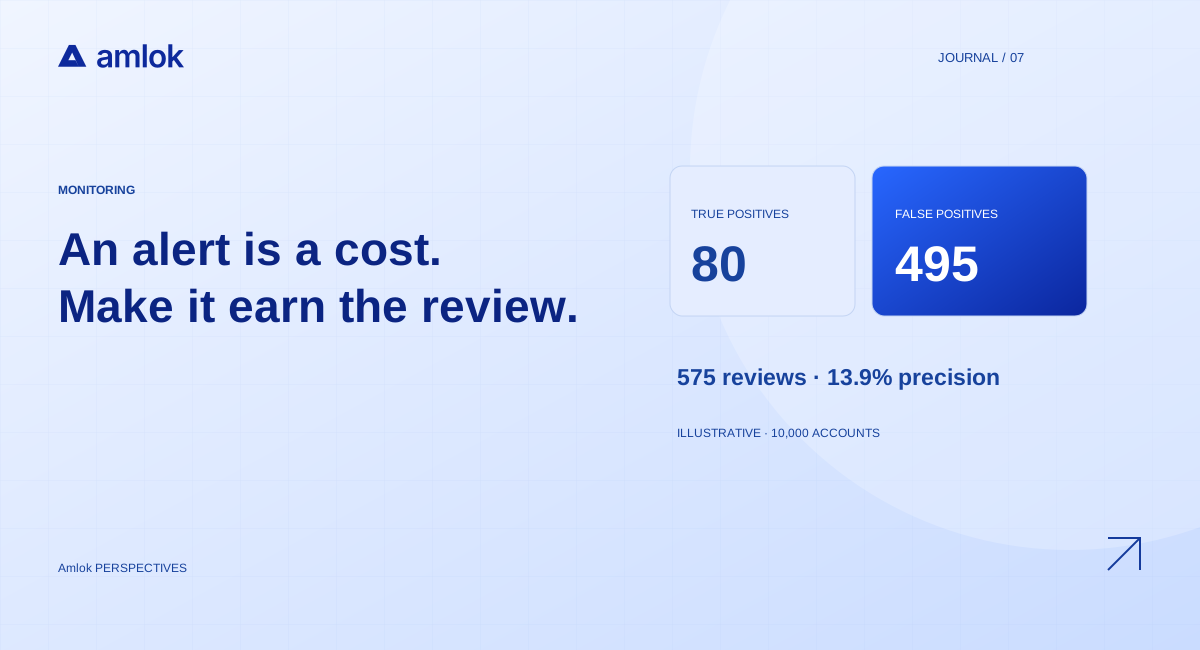
Use time-based evaluation, inspect connected-borrower overlap, and report cohort performance by product, vehicle category, and source coverage. For any proposed monitoring signal, measure warning lead time against an event defined in advance and include the false-alert workload. Aggregate ranking performance does not tell an operations team how many cases it will need to review. [5]
Amlok’s currently published supervised results concern SBA-reported charge-offs in a US government-guaranteed business-loan sample. They do not validate auto lending. An auto-specific study needs its own authorized data, target, comparison, and uncertainty analysis. [6]
Sources & methodology.
Figures identify their population, period, and units. Scenarios marked illustrative are Amlok calculations using stated assumptions, not observed customer outcomes.
- 1Auto finance workflowsAmlok research and product documentation
Separate borrower affordability, vehicle value, finance structure, and realized recoveries.
- 2Breaking Down Auto Loan PerformanceFederal Reserve Bank of New York · 13 February 2025
US Consumer Credit Panel/Equifax, through Q4 2024. Origination volumes are not Canadian default or collateral-loss estimates.
- 3Consumer underwriting researchAmlok research and product documentation
Affordability, temporal evidence, and consumer-specific evaluation requirements.
- 4Monitoring and change detectionAmlok research and product documentation
Proposed monitoring design, observation windows, baselines, and evaluation requirements.
- 5Evaluation designAmlok research and product documentation
Evaluation protocols and research objectives. A specified protocol is not evidence that an experiment has been completed.
- 6Research model cardAmlok research and product documentation
Intended uses, exclusions, status of model development, and limits to generalization.