
The idea in brief.
A change is meaningful only relative to a comparison. Monitoring that does not preserve the original evidence and assumptions can confuse a new source, a corrected record, or a changed formula with a change in financial condition. [1]
- Retain event time and the time the information became available.
- Freeze the calculation definition as well as the original value.
- Treat source changes and economic changes as different events.
The examples are illustrative process designs. This article does not report measured warning lead time or borrower outcomes.
The baseline is more than a number
A stored monthly-revenue figure is not enough to reproduce an assessment. A baseline also needs the period, source accounts, transaction classifications, exclusions, currency, and formula version. If one of these changes, the difference may be methodological rather than economic.
Consider an illustrative merchant showing CAD 100,000 in monthly receipts at approval and CAD 130,000 later. If a second processor was connected in the later period, the observed increase may reflect better coverage. Comparing the two totals without a coverage note would suggest growth that has not been established. [2]
Keep two clocks
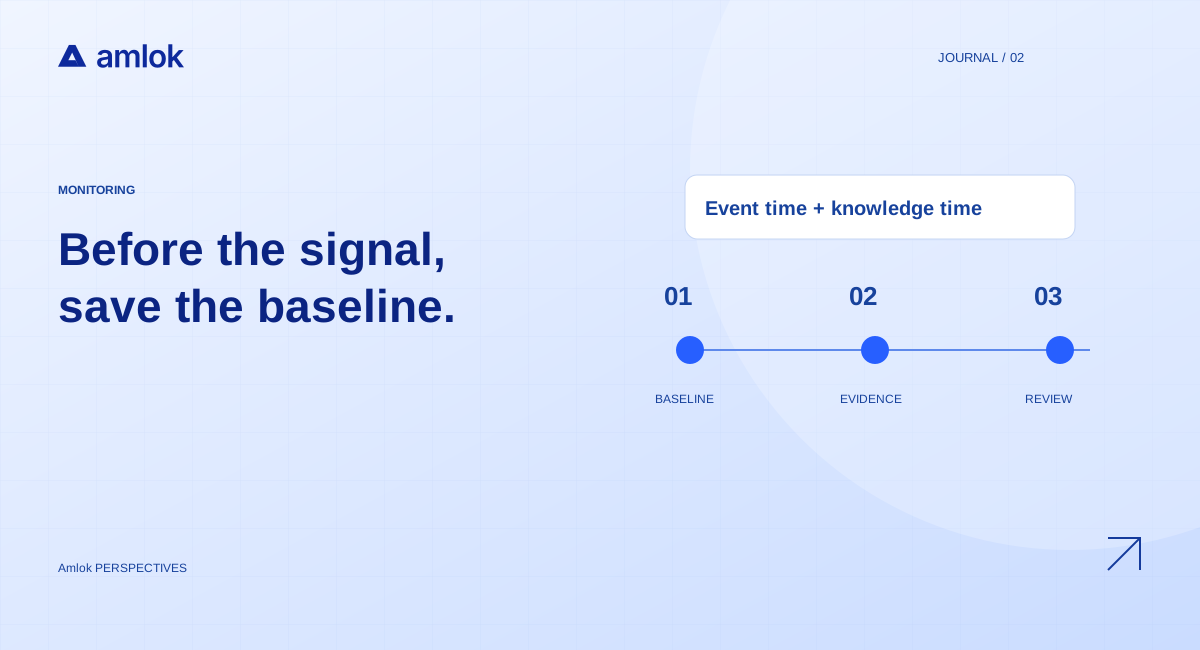
Event time describes when something happened. Knowledge time describes when the reviewer or system could know it. A financial statement can concern a year that ended months before publication. A backfilled transaction may arrive well after its posting date. Both dates are needed for a faithful reconstruction.
A retrospective test that uses later-published evidence as if it were known at origination can overstate usefulness. The same problem can arise in a monitoring dashboard when backfilled records appear as fresh activity. Preserve the arrival and revision history, and evaluate the system using the information actually available at each decision point. [2][3]
A change record should preserve both clocks
- 01Event occurs
The business or account changes.
- 02Evidence arrives
The source publishes or delivers the record.
- 03Comparison runs
A versioned baseline and definition are applied.
- 04Review is recorded
The institution documents its interpretation.
A correction is not deterioration
Suppose a transaction previously classified as sales is corrected to a financing inflow. The calculated operating-receipts figure falls, but the underlying business has not suddenly lost revenue at the moment of correction. The system has learned that its earlier interpretation was wrong.
A useful change log distinguishes newly observed activity, late-arriving records, source corrections, revised classifications, and formula changes. The reviewer can then decide whether to revisit the original assessment, investigate current conditions, or simply update the historical record. [1]
Evaluate the signal against its purpose
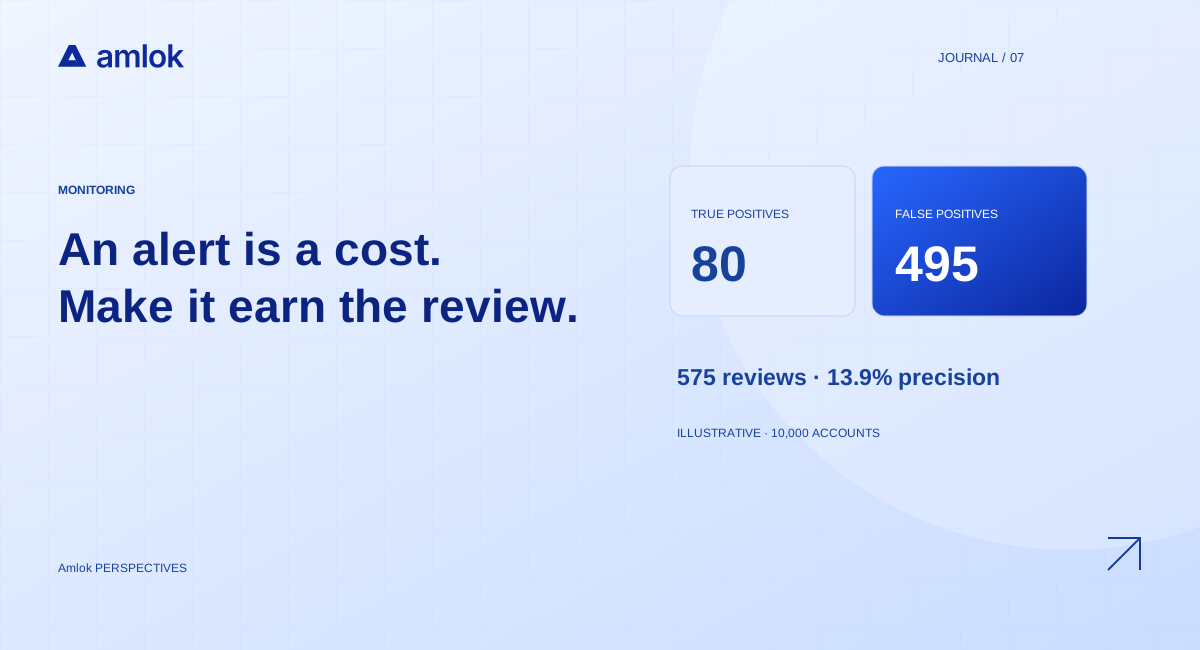
For a monitoring pilot, define the event that a warning is intended to precede and the action a team can reasonably take. Measure lead time, missed events, false-alert workload, and the proportion of signals with complete evidence. A count of generated alerts is not a measure of effectiveness.
Preserve a future evaluation window and avoid selecting thresholds after inspecting the outcome period. Report results under different coverage conditions. Amlok’s current public baselines do not measure monitoring lead time, so a claim about earlier intervention requires a separate study. [3][4]
Sources & methodology.
Figures identify their population, period, and units. Scenarios marked illustrative are Amlok calculations using stated assumptions, not observed customer outcomes.
- 1Monitoring and change detectionAmlok research and product documentation
Proposed monitoring design, observation windows, baselines, and evaluation requirements.
- 2Financial record modelAmlok research and product documentation
Proposed representation of source, entity, amount, period, event time, and knowledge time.
- 3Evaluation designAmlok research and product documentation
Evaluation protocols and research objectives. A specified protocol is not evidence that an experiment has been completed.
- 4Research model cardAmlok research and product documentation
Intended uses, exclusions, status of model development, and limits to generalization.