
The idea in brief.
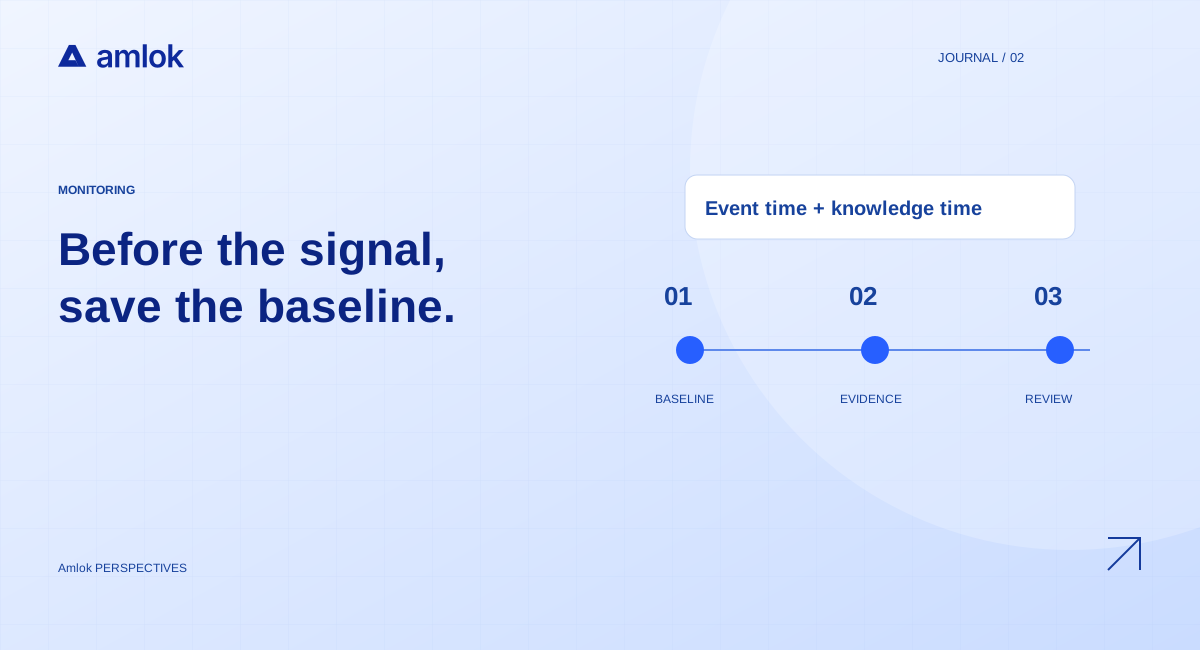
An underwriting decision rests on facts, assumptions, and exceptions. If monitoring retains only the final score, it loses the reasons the institution considered the exposure acceptable and the conditions that would justify another review. [1]
- Preserve the evidence and assumptions behind the decision.
- Turn material assumptions into reviewable follow-up questions.
- Record the response and outcome, not just the alert.
This article proposes a review design with illustrative examples. It does not claim measured reduction in defaults or a validated monitoring lead time.
What made the decision reasonable?
A credit memo may rely on stable customer receipts, the completion of a refinancing, or the expected collection of a large receivable. Some of these are observed facts; others are conditional expectations. They should not become indistinguishable once the decision is recorded.
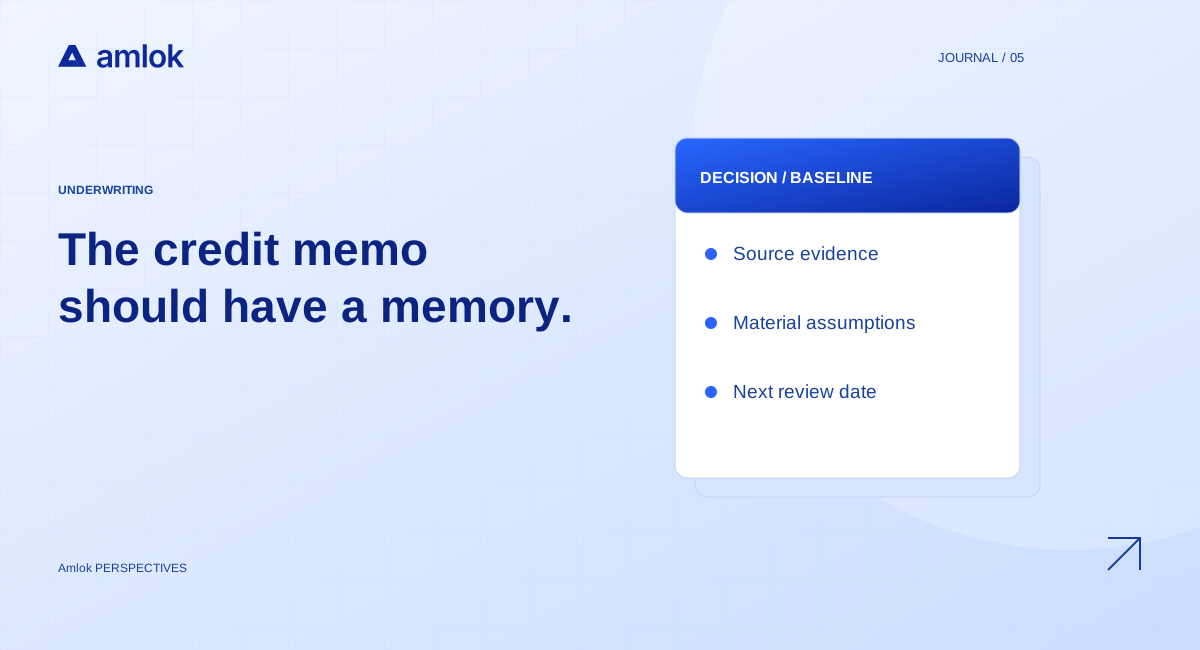
For each material assumption, retain its source, the date it was made, the person or team responsible for review, and the evidence that would confirm or challenge it. An exception should have the same treatment. This creates a specific monitoring purpose rather than a generic instruction to watch everything. [2][3]
Translate assumptions into questions
Consider a hypothetical business approved partly on the expectation that a CAD 150,000 receivable will be collected within 30 days. A useful follow-up asks whether that invoice was paid, extended, disputed, or replaced by another arrangement. A broad revenue-change alert may miss the original dependency.
The monitoring design should link the invoice, its expected collection date, and subsequent payment evidence. If the source is incomplete, the result should be “not yet verified,” not “unpaid” by default. A reviewer can then request the missing evidence or interpret the delay.
Give the decision an explicit follow-up path
- 01Decision assumption
A material receivable is expected to convert to cash.
- 02Evidence deadline
Define when and how collection will be checked.
- 03Comparison
Match payment, extension, dispute, or missing data.
- 04Review outcome
Document the response and revise the assessment.
Keep the original and the revised view
When an assumption changes, retain both versions. A subsequent explanation may make the new situation acceptable, but it should not rewrite what the institution knew at approval. This history supports learning about which assumptions were reliable and which repeatedly required exceptions.
The same principle applies to formulas and entity mappings. If a new account or related business is added, document the change in scope. Otherwise a reviewer may interpret a revised measure as a change in borrower behaviour. [2]
Measure the quality of the handoff
An operational pilot can assess the share of decisions with traceable assumptions, the proportion of follow-ups completed on time, the evidence completeness of review packets, and whether reviewers agree on the next action. These are useful process measures that do not require pretending a short pilot can already establish long-run credit performance.
A separate outcome study should define the event, horizon, comparator, and uncertainty. It should distinguish a signal that arrived earlier from a response that actually improved an outcome. Amlok’s current public research baselines do not establish that causal effect. [4][5]
Sources & methodology.
Figures identify their population, period, and units. Scenarios marked illustrative are Amlok calculations using stated assumptions, not observed customer outcomes.
- 1Monitoring and change detectionAmlok research and product documentation
Proposed monitoring design, observation windows, baselines, and evaluation requirements.
- 2Financial record modelAmlok research and product documentation
Proposed representation of source, entity, amount, period, event time, and knowledge time.
- 3Business underwriting researchAmlok research and product documentation
Financial relationships, debt obligations, cash conversion, and research boundaries.
- 4Evaluation designAmlok research and product documentation
Evaluation protocols and research objectives. A specified protocol is not evidence that an experiment has been completed.
- 5Research model cardAmlok research and product documentation
Intended uses, exclusions, status of model development, and limits to generalization.