
The idea in brief.
An event tells a system that something happened. It does not by itself explain what should happen next. A reviewable workflow preserves the evidence, applies an explicit rule, and records who owns the response. [1]
- Separate event receipt, evidence assessment, and consequential action.
- Design for duplicates, late arrivals, and corrected records.
- Make exceptions and human ownership visible in the workflow.
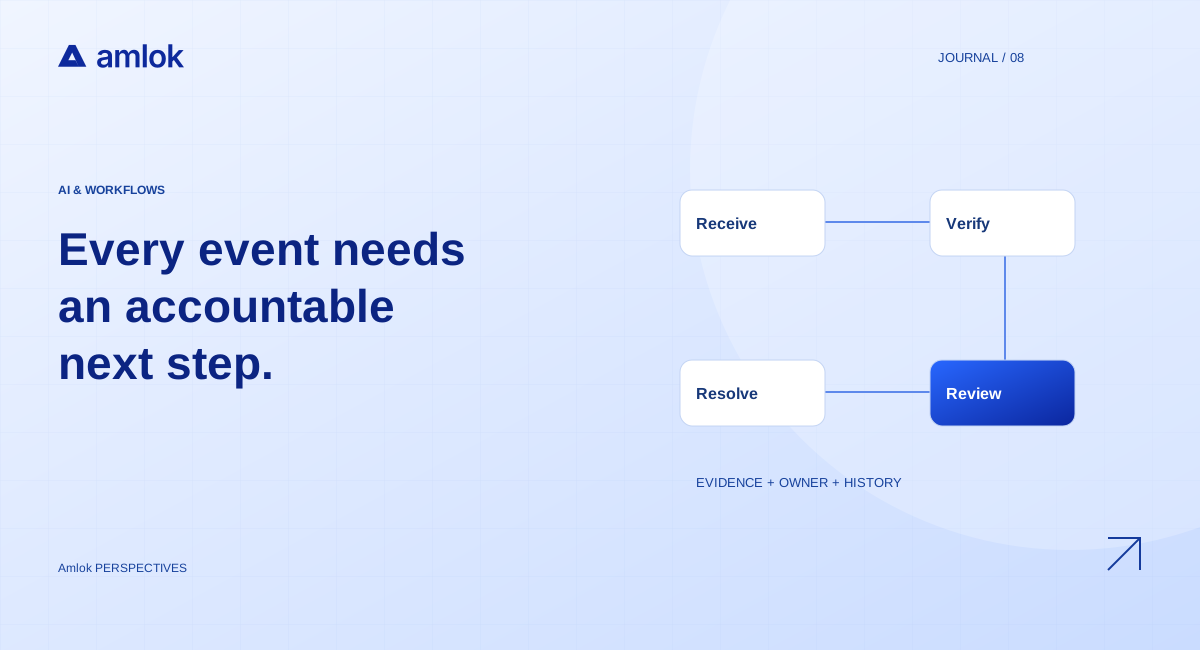
This article proposes workflow design patterns. The diagram is conceptual and does not claim a particular API delivery guarantee or measured automation outcome.
A notification is not a decision
A changed balance, a newly available statement, or an updated relationship can trigger a useful reassessment. The first task is to establish what the event represents and whether the relevant evidence is complete. A financial action should not follow merely because a notification arrived.
The workflow should preserve the source record, event time, arrival time, and the affected entity or assessment. It should then identify the rule or policy version used to route the case. This allows a later reviewer to explain why the system did what it did. [2]
Design the state transitions
A proposed workflow can distinguish received, verified, assessed, awaiting review, resolved, and superseded states. Each transition needs a condition and an owner. If evidence is missing, the case should wait or request a refresh rather than silently pass through a step that assumes completeness.
Keep the analytical result separate from the institution’s decision. A signal can recommend a review or summarize a change while an authorized person or policy process determines the response. A correction should be able to supersede an earlier assessment without deleting its history.
Evidence moves through explicit states
- 01Receive & deduplicate
Identify the event and retain the original payload.
- 02Verify evidence
Check identity, coverage, timestamps, and prerequisites.
- 03Route for review
Apply a versioned rule and assign an accountable owner.
- 04Resolve & preserve
Record the action, rationale, and superseded states.
Expect the messy cases
Duplicate delivery should not create duplicate consequential actions. A late event should be evaluated against the correct historical context, not assumed to be current. A revised source record should trigger a controlled reconsideration of affected calculations. These are design requirements to test against the actual integration contract.
For example, if a payment correction reverses a previously matched receipt, a workflow should identify the assessments that depended on that match. The next step might be a new evidence review, not an automatic collection instruction. The appropriate response belongs to the institution’s policy and authorized team.
Audit the workflow as a system
Test the normal path and the failure paths: missing source data, conflicting identifiers, repeated events, out-of-order delivery, revised policy, and unavailable reviewers. Measure whether cases reach a valid state and whether their evidence remains traceable. A successful task execution is not the same as a correct financial decision.
NIST’s voluntary AI risk-management framework provides a general reference for accountability and evaluation. The practical implementation still needs a clearly defined use, controls, and evidence that those controls work. Amlok’s proposed workflow methods should be evaluated at that level rather than described as validated merely because automation runs. [3][4]
Sources & methodology.
Figures identify their population, period, and units. Scenarios marked illustrative are Amlok calculations using stated assumptions, not observed customer outcomes.
- 1Monitoring and change detectionAmlok research and product documentation
Proposed monitoring design, observation windows, baselines, and evaluation requirements.
- 2Financial record modelAmlok research and product documentation
Proposed representation of source, entity, amount, period, event time, and knowledge time.
- 3Artificial Intelligence Risk Management Framework 1.0NIST · January 2023
Voluntary risk-management framework; references to it do not imply certification or a completed conformity assessment.
- 4Evaluation designAmlok research and product documentation
Evaluation protocols and research objectives. A specified protocol is not evidence that an experiment has been completed.