Amlok
The idea in brief.
In trade credit insurance, the insured business, its buyers, its invoices, and the policy are different objects. Their relationships determine how a financial change should be investigated. Connecting those objects can make a review more precise without treating every anomaly as a covered claim. [1]
- Measure concentration at the relevant economic group, while retaining separate legal entities.
- A deterioration signal is not a coverage determination; policy terms and claim facts need their own review.
- Test evidence quality and review consistency before asserting a loss-ratio or pricing benefit.
This is a methodological whitepaper, not an actuarial pricing study. All portfolio amounts below are illustrative CAD examples. The discussion concerns trade credit; it does not validate life, health, motor, premium-finance, or surety models.
Keep four records distinct
An invoice records an obligation between a seller and a buyer. A payment records movement against that obligation. A policy defines a contractual relationship with conditions, limits, exclusions, and dates. A claim records an asserted covered loss and its subsequent handling. Combining them into a single “risk record” can erase the distinctions that matter most.
A proposed evidence model should link these records without making them identical. Preserve the original invoice value, due date, disputes, partial payments, and currency. Attach the buyer’s legal identity, any related-group hypothesis, and the evidence supporting that relationship. Keep policy versions and applicable periods so that a later contract change does not rewrite an earlier assessment. [1][2]
For example, a late invoice may be disputed, extended by agreement, or partly paid. Those explanations have different implications. A monitoring system should route the case with the relevant evidence and unresolved questions, rather than infer a covered default from lateness alone.
From exposure to a reviewable decision
- 01Buyer & group
Resolve identity and inspect connected obligations.
- 02Invoice & payment
Track due dates, disputes, and partial settlement.
- 03Policy & limit
Apply the relevant version and coverage conditions.
- 04Review & claim
Document the assessment and accountable owner.
See concentration through relationships
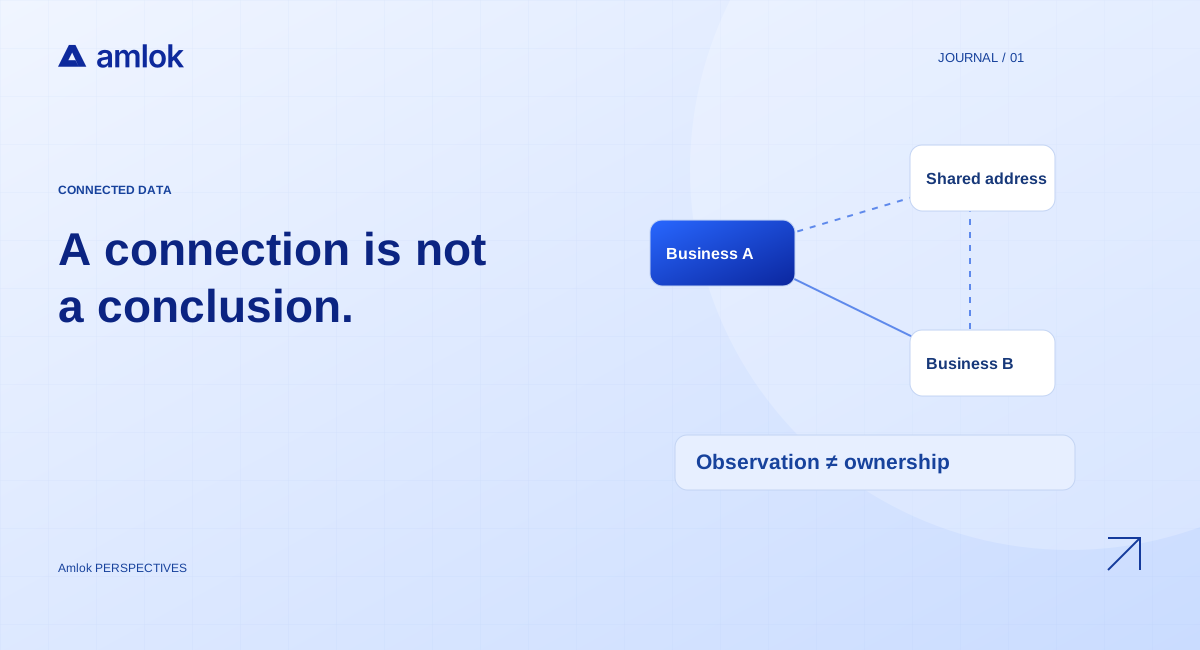
Consider a hypothetical receivables book of CAD 1 million. Buyer A owes CAD 350,000, B owes CAD 250,000, C owes CAD 200,000, and D owes CAD 200,000. The largest legal-name exposure is 35%. If A and B are verified members of the same economic group, the connected group represents 60% of the book.
The amounts have not changed. The interpretation has. One shared dependency may affect more exposure than the legal-name view reveals. Conversely, an unverified name match should not automatically consolidate buyers. Review the ownership evidence, effective dates, and degree of control, and preserve the ability to reverse a mistaken connection.
Group concentration is still not expected loss. Contracts, guarantees, payment terms, jurisdictions, and risk mitigants can differ within a group. Use the connected view to prioritize a review, then inspect the underlying obligations. A single concentration percentage cannot encode every contractual distinction. [3]
Same receivables. Different concentration view.
View figure data
| Measure | Value |
|---|---|
| Largest legal-name buyer | 35% |
| Largest connected group | 60% |
Separate changing exposure from changing data
A buyer’s apparent arrears can rise because an invoice feed arrives before a payment file. A customer may move to a different billing entity. An accounting-system migration can create duplicate open items. Before assigning economic meaning, reconcile observations across sources and record when each became available.
Use aging buckets with explicit definitions. For example, “days past due” should reference the contractual due date and reflect approved extensions consistently. Separate disputed items, credits, and pending cash application from undisputed overdue balances. If a policy or reporting convention requires a different treatment, make that difference visible rather than burying it in a transformation.
The monitoring baseline should include the last reconciled state, source completeness, and outstanding exceptions. A review can then ask whether exposure increased, payment timing worsened, coverage changed, or information became less reliable. These are different causes and should not share an undifferentiated alert. [4]
| Question | Evidence to retain | Uncertainty to surface |
|---|---|---|
| Who owes the amount? | Legal identifier, invoice, source system | Unresolved aliases or group links |
| When should it be paid? | Terms, due date, amendments | Disputed or extended invoices |
| What remains outstanding? | Cash application and credit notes | Unmatched or delayed payments |
| Which policy applies? | Policy version, limit, effective period | Coverage interpretation requiring review |
Measure the right denominator
Claims frequency, overdue-invoice share, and loss ratio describe different populations. A claim count needs an exposure definition and time window. An overdue-invoice measure can be weighted by count or amount. A loss ratio requires consistent premium and loss recognition conventions. Never label all three “risk rate.”
For a hypothetical invoice sample, 20 overdue invoices among 200 is a 10% count-based rate. If those invoices represent CAD 150,000 out of CAD 1 million outstanding, the amount-weighted rate is 15%. Neither is a claims frequency. Including this distinction in dashboards helps reviewers understand whether a movement reflects more cases, larger cases, or both.
When evaluating a proposed signal, preserve a future outcome window and account for policies or invoices that have not yet matured. A short observation period can miss later claims. An apparent improvement may also reflect changed underwriting or collection practices rather than a better model. The study design should describe those competing explanations. [5]
Put governance inside the evidence flow
EIOPA’s August 2025 opinion addresses AI governance and risk management in European insurance supervision. It provides jurisdiction-specific context for proportional oversight, rather than a certification for a particular product. An institution should determine the requirements relevant to its own deployment. [6]
Our proposed operational design makes review possible at the level of the claim: the source invoice, the inferred relationship, the calculation, and the reason for escalation. Permissions should follow the purpose for which the data is used. A reviewer should be able to distinguish an observed fact from a model inference and record a correction without destroying the original record.
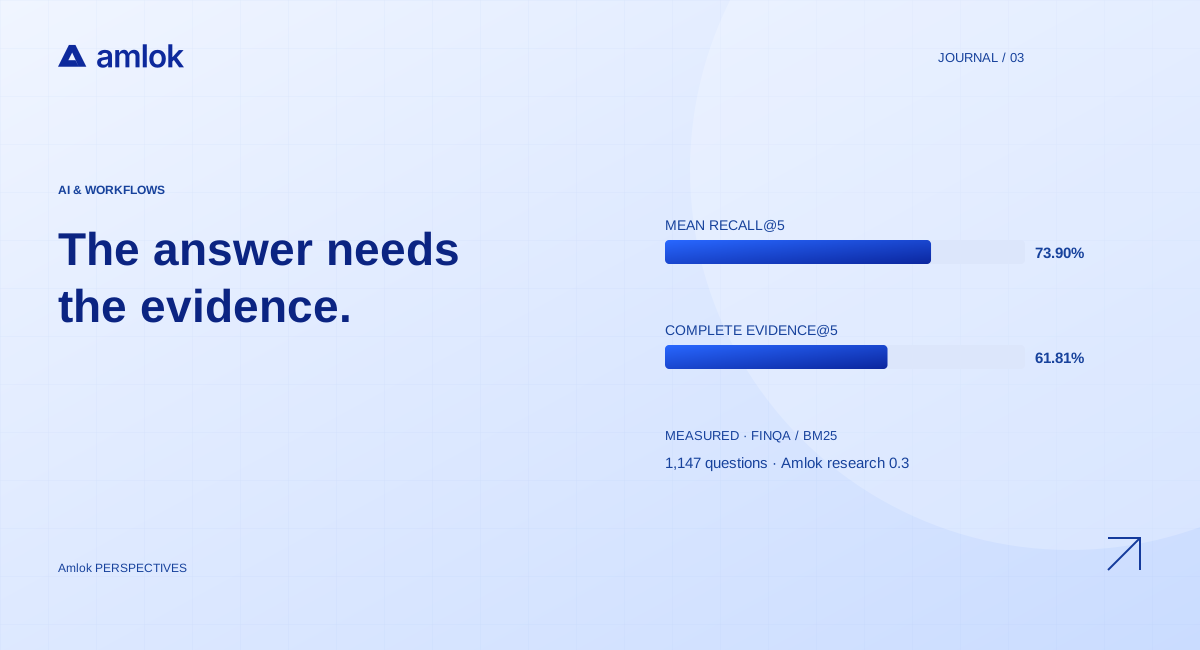
A practical pilot can measure duplicate-invoice detection, reconciliation coverage, time to resolve exceptions, and agreement on escalation. Only a separate outcome study can support statements about claim reduction or pricing accuracy. The current Amlok research baselines do not establish insurance-loss performance. [7]
Sources & methodology.
Figures identify their population, period, and units. Scenarios marked illustrative are Amlok calculations using stated assumptions, not observed customer outcomes.
- 1Trade credit insurance workflowsAmlok research and product documentation
Seller, buyer, invoice, policy, and claims are separate units of analysis.
- 2Financial record modelAmlok research and product documentation
Proposed representation of source, entity, amount, period, event time, and knowledge time.
- 3Entity and relationship graphAmlok research and product documentation
Research design for provenance, entity resolution, relationship types, and uncertainty.
- 4Monitoring and change detectionAmlok research and product documentation
Proposed monitoring design, observation windows, baselines, and evaluation requirements.
- 5Evaluation designAmlok research and product documentation
Evaluation protocols and research objectives. A specified protocol is not evidence that an experiment has been completed.
- 6Opinion on Artificial Intelligence governance and risk managementEIOPA · 6 August 2025
European supervisory opinion on insurance AI. Jurisdiction-specific context, not a statement of Canadian legal obligations.
- 7Research model cardAmlok research and product documentation
Intended uses, exclusions, status of model development, and limits to generalization.