
The idea in brief.
A clean connection experience can hide an uneven evidence picture. The user may authorize one account, one processor, or one time window. The analytical result needs to make those boundaries as clear as the connection itself. [1]
- Show what is connected, current, and missing as separate states.
- Carry authorization scope into the analysis.
- A newly connected source can change the measurement without changing the business.
This article describes data-quality and product-design principles. Its coverage example is hypothetical and is not an Amlok integration-success statistic.
Access is only one dimension
A connection can be technically healthy while the relevant history is incomplete. A source can be current but cover only one of several accounts. A complete historical export can be too stale for a particular monitoring question. These are distinct conditions, and a single green “connected” badge cannot explain all of them.
A useful evidence summary records authorized sources, included accounts, covered dates, last successful refresh, and known gaps. It should also explain how those gaps affect a calculation. An operating-receipts estimate based on one processor should not imply coverage of the merchant’s entire business. [2][1]
Changing coverage changes the comparison
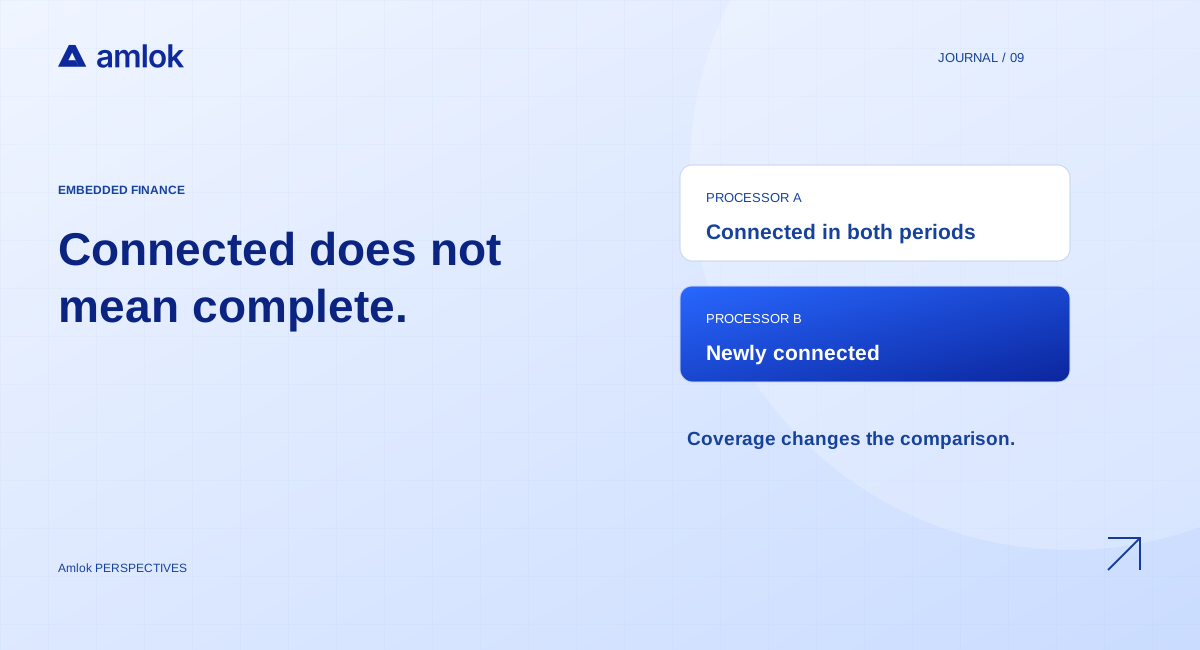
Imagine a merchant uses two processors. The first shows CAD 70,000 in receipts and is connected in both months. The second shows CAD 30,000 but is connected only in the later month. Observed receipts rise from CAD 70,000 to CAD 100,000 even if activity at both processors is unchanged.
The apparent 42.9% increase is a coverage effect: 30,000 ÷ 70,000. A comparable-source view would compare the first processor across both months and disclose the new source separately. Backfilled history could later support a fuller comparison, but that revision should be visible.
Carry coverage into every comparison
- 01Earlier window
Processor A observed: CAD 70,000.
- 02Later window
A plus newly connected B: CAD 100,000.
- 03Coverage check
CAD 30,000 comes from the newly observed source.
- 04Comparable view
Compare A with A; disclose B and any backfill separately.
Permission should remain attached to purpose
The product should make the scope of access understandable and preserve it in downstream processing. Data collected for one workflow should not silently expand into unrelated uses. Retain the authorization context and apply the institution’s handling rules throughout the evidence chain.
If authorization expires or is revoked, distinguish loss of access from an account with no activity. The exact retention and operational response depend on the applicable agreement and requirements; the analytical system should expose the state rather than invent a zero value. [1]
Test incomplete journeys
A realistic integration evaluation includes partial connections, account switching, delayed refreshes, duplicate observations, and source corrections. Measure how well the product explains each state and whether calculations remain traceable. A demonstration with every source available does not establish resilience under missingness.
For predictive claims, separate the effect of additional data from the effect of a different model. Compare like-for-like source coverage and include platform or institution holdouts when transfer is the intended claim. Amlok’s current published baselines do not establish embedded-finance outcome performance. [3][4]
Sources & methodology.
Figures identify their population, period, and units. Scenarios marked illustrative are Amlok calculations using stated assumptions, not observed customer outcomes.
- 1Embedded finance workflowsAmlok research and product documentation
Data coverage, consent, platform context, and economic-event reconciliation.
- 2Financial record modelAmlok research and product documentation
Proposed representation of source, entity, amount, period, event time, and knowledge time.
- 3Evaluation designAmlok research and product documentation
Evaluation protocols and research objectives. A specified protocol is not evidence that an experiment has been completed.
- 4Research model cardAmlok research and product documentation
Intended uses, exclusions, status of model development, and limits to generalization.