Amlok
The idea in brief.
Digital origination can move an application quickly without making its evidence complete. A useful lending workflow needs both operational speed and a clear account of what supports the assessment. This guide describes how Insights can sit inside a digital application journey and how Signal can follow an approved exposure, with coverage, exceptions and reviewer effort measured alongside completion time.
- Measure the full application journey, including retries and human correction.
- Keep insufficient evidence separate from an adverse credit conclusion.
- Compare workflow quality on the same product, channel and evidence snapshot.
A practical implementation guide grounded in Amlok’s documented product scope and segment research. Market figures retain their original population and period. Worked examples are invented, reproducible scenarios. They do not represent customer results, underwriting cutoffs or claims of validated model performance.
The market and the decision.
The Federal Reserve Banks’ 2025 report on the 2024 Small Business Credit Survey found full approval rates of 54% among US employer-firm applicants at small banks, 45% at large banks and 30% at online lenders. This weighted nonprobability survey reflects different applicant populations; it is not a causal comparison of lender quality. [1]
The lesson for a digital lender is to define the funnel before reporting a rate. Visitors, started applications, eligible applications, complete-evidence files and decided cases are different denominators. A fast process that silently excludes difficult evidence can look better without serving more applicants reliably.
Approval rates depend on the population
View figure data
| Measure | Value |
|---|---|
| Small banks | 54% |
| Large banks | 45% |
| Online lenders | 30% |
What Amlok brings to the workflow.
Insights supports an authorized underwriting workflow using a ready, frozen input manifest. A digital lender can connect application and permitted evidence collection to the resulting risk snapshot, while explicitly handling missing sources and unresolved verification. The completed result is advisory input to the institution’s decision. [2] [3]
The integration opportunity is a clear contract between application experience and credit review: what was collected, what is ready, what remains unavailable and what evidence supports the assessment. Signal then provides change-driven reassessment from an approved baseline. Amlok’s workflow does not replace the lender’s customer interface, eligibility policy or decision authority.
Connect the evidence that matters.
Agree the evidence perimeter before asking for an assessment. Each record needs a subject, source, observation date, currency where applicable, and coverage window. Resolve conflicting statements explicitly; the most recently uploaded file is not necessarily the most recent financial position. [3]
| Evidence | What it supports | Review requirement |
|---|---|---|
| Application and channel records | Requested product, amount, eligibility and submission history | Retain the funnel denominator and deduplicate repeated submissions. |
| Consent and source connections | Permission, account scope and evidence readiness | A connected provider does not guarantee required history. |
| Identity and verification results | Supported checks and unresolved review states | Completed processing does not automatically mean verified identity. |
| Financial and contractual evidence | Income, cash flow, obligations and proposed terms | Freeze the same evidence window for comparative evaluation. |
| Review and outcome records | Corrections, elapsed time, decisions and later repayment | Rejected cases do not acquire repayment labels from rejection alone. |
Measures your team can review.
Use the definitions below as an assessment specification. Your institution selects policy thresholds and permitted adjustments. These measures are useful only when their inputs, time periods and contractual meanings align. [4]
- Application coverage: eligible files with sufficient authorized evidence for the defined assessment.
- End-to-end assessment time: collection, synchronization, processing, retries and human review included.
- Evidence error: unsupported fields, wrong amounts, missed obligations and unreconciled records per reviewed file.
- Abstention: cases requiring more evidence or human interpretation, with reasons and later resolution.
- Credit outcomes: product-specific calibration, arrears and mature loss by channel and vintage.
Worked example: three valid rates, three different questions.
Assume an illustrative digital funnel begins with 1,000 applications. Of these, 800 meet defined eligibility rules, 600 have the required evidence, and 420 are approved by the lender. Approval is 42% of all applications, 52.5% of eligible applications or 70% of evidence-complete applications.
None of these figures is intrinsically wrong, but reporting only the highest one hides the collection and coverage experience. Track where cases stop, why evidence is unavailable, and whether manual review resolves them. These invented counts illustrate denominators; they are not conversion or approval targets.
| Measure | Count | Share of preceding stage |
|---|---|---|
| Started applications | 1,000 | Not applicable |
| Policy-eligible applications | 800 | 80% |
| Required evidence complete | 600 | 75% |
| Lender approvals | 420 | 70% |
| Approvals / all applications | 420 / 1,000 | 42% |
Keep the original decision in view.
After funding, retain the decision snapshot rather than rebuilding the borrower’s history from whatever data happens to be current. Signal can compare supported financial changes with that baseline and deliver evidence to the lender’s system through the agreed integration.
A provider outage, duplicated event and genuine payment deterioration need different handling. Monitor coverage and freshness alongside the financial result. The lender owns customer communications, servicing and any adjustment to the credit relationship; a notification is not an instruction to execute an action. [3]
From evidence to a reviewable change
- 01Collect with purpose
Define eligibility, authorization and required evidence.
- 02Assess a frozen file
Separate ready inputs, exceptions and missing coverage.
- 03Record the lender decision
Retain the assessment and the institution’s reasoning.
- 04Monitor after funding
Compare supported changes with the approved baseline.
Build it into your operating model.
Start with one defined use case, your current decision policy and the output your reviewers need. Confirm which source connections, document types, calculations and verification stages are available within the agreed workflow. Create the subject and application, obtain the required authorization, synchronize permitted records and inspect the ready input manifest. Freeze that evidence window before launching an Insights underwriting run. [3]
Store the completed risk snapshot with the lender’s actual decision and its reasons. For ongoing monitoring, use a ready approved baseline from the completed assessment or the agreed existing-portfolio onboarding process. Signal compares newly available evidence with that baseline. Signed webhooks notify your systems; source cadence and consent determine freshness. A requested daily check does not guarantee daily source data. [3]
Design separate routes for a supported risk change, a source outage and an unresolved discrepancy. Retain source references and reviewer corrections. Borrower outreach, payments, limit changes, collections and insurance administration remain in your authorized systems. Verification and analytical investigation are included stages within an entitled Insights or Signal workflow, not independent Amlok products. [2]
Prove the fit before expanding.
Use a temporal holdout and a held-out acquisition channel where feasible. Score fraud or identity outcomes separately from repayment risk. Compare systems on identical permitted evidence rather than one having richer source access. [4]
Test repeated applications, delayed provider updates and partial data. Report completed outputs, review effort and unresolved files together. If the workflow saves time, measure the entire operational process; processing latency alone omits the work most likely to move back to analysts.
Agree success criteria before reviewing the test results. Compare the current process and the Amlok-supported process on the same permitted evidence, recording analyst time, corrections, unresolved cases and completed outputs. Report coverage alongside speed so incomplete files cannot make the workflow appear faster. Monitor quality by source availability and relevant customer cohorts, with uncertainty where samples are small.
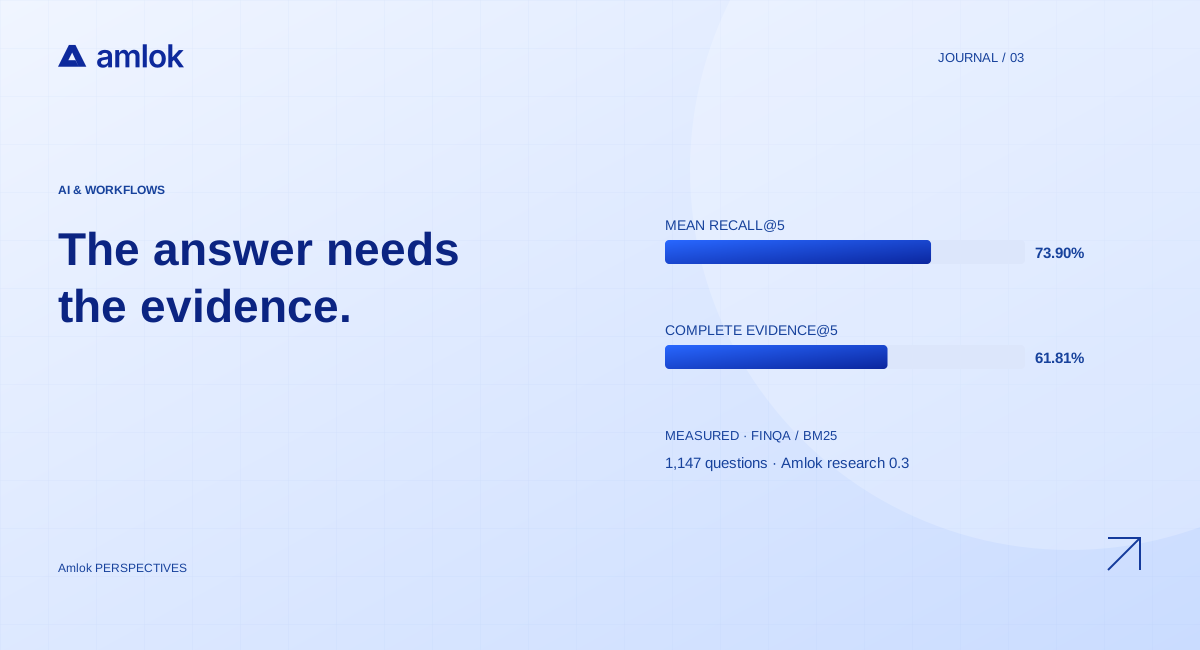
Amlok’s public results currently document specific structured-loan and financial-evidence retrieval experiments. Those results are useful evidence about those tasks; they do not validate every product, institution or industry in this guide. A deployment claim needs a representative evaluation of your use case. [5]
- Scope: choose one product, one decision moment, required evidence and a clearly accountable reviewer.
- Replay: use dated historical snapshots with later outcomes kept out of the input evidence.
- Shadow: compare outputs alongside your existing process before relying on them operationally.
- Expand: review quality, data continuity and monitoring relevance before adding further cohorts or sources.
Sources & methodology.
Figures identify their population, period, and units. Scenarios marked illustrative are Amlok calculations using stated assumptions, not observed customer outcomes.
- 12025 Report on Employer Firms: Findings from the 2024 Small Business Credit SurveyFederal Reserve Banks
Financing applications, page 17: full approval among US employer-firm applicants at each source. Weighted nonprobability survey, not randomized lender assignment or a Canadian approval benchmark.
- 2Products and endpoint scopeAmlok
Documented ownership of Insights, Signal and included processing stages. Workflow availability and provider coverage depend on the agreed implementation.
- 3Integration workflowsAmlok
Frozen input manifests, immutable risk snapshots, approved monitoring baselines, source-dependent refresh and institution-owned intervention.
- 4Digital Lenders benchmark and evaluation definitionsAmlok
Segment-specific research definitions and proposed evaluation tasks. This is a research framework, not a claim of completed segment validation.
- 5Measured research resultsAmlok
Published SBA structured-loan and FinQA retrieval experiments have limited populations and tasks. They do not establish performance for this segment.